
Biometric Corridors – an end to airport queues?
By Alan Goode, CEO and Chief Analyst, Goode Intelligence
Airline travelers are experiencing significant frustration with airport queues, with a study by SITA showing that 21 percent of passengers identify long waiting lines as a top issue, trailing only behind flight delays and cancellations. These delays are frequently driven by staffing shortages, increased passenger volume, and tightened border controls, leading to “nightmare” scenarios for travelers, particularly in European hubs.
Biometrics is seen as a solution to this problem but it has to be deployed in the context of maintaining high levels of security. Allowing authorized travelers through borders in an efficient and timely way is a must-have for the air travel industry.
At PTE World London 2026 I was interested in discovering what the air travel industry was doing to streamline air travel and how they were leveraging biometrics to achieve this aim.
PTE World is a three-day annual event for the international airport industry that connects over 11,000+ airport/airline executives, 400+ exhibitors, and 500+ expert speakers to showcase technology and discuss future airport design, security, and sustainable operations.
Biometrics featured heavily at the show with many leading airline technology suppliers and systems integrators offering biometrics as part of their offerings, including SITA, Amadeus, dormakaba, and IDEMIA.
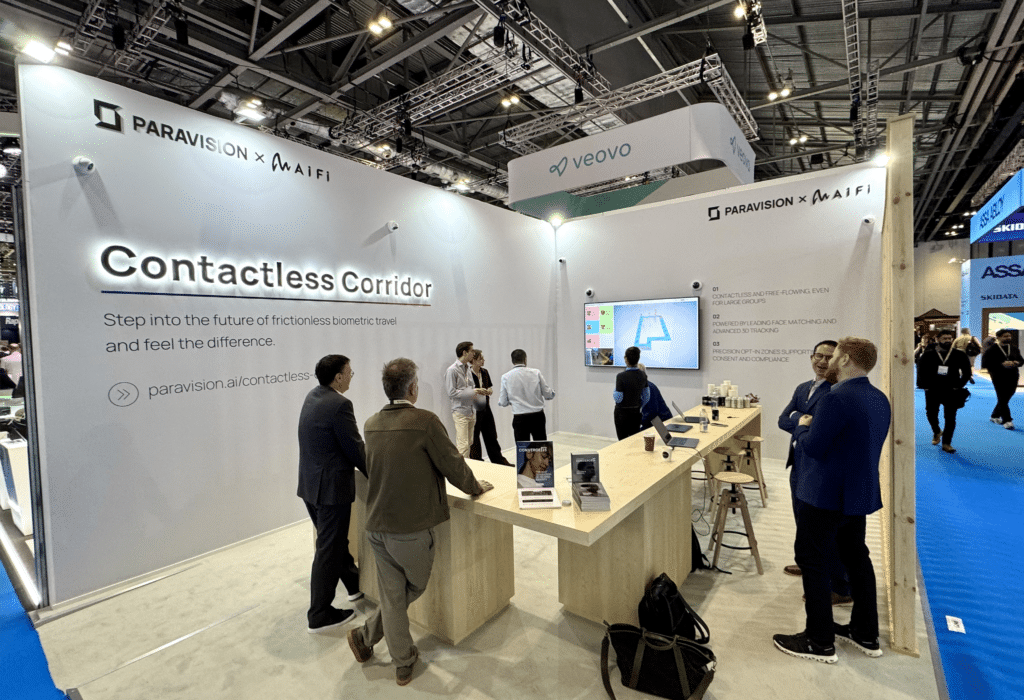
I caught up with Identity AI provider, Paravision to talk about their latest developments and trends in the air travel world at the event. Joey Pritikin, Chief Product Officer at Paravision was on hand to talk, and walk, me through the center-piece of their stand, their partnership with AI-powered, camera-first, vision technology vendor, AiFi Inc, in developing biometric corridors suitable for use in biometric entry and exit at airports.
Pritikin stressed that the Contactless Corridor “has been built on the success of core Paravision technology, including facial recognition, liveness, and deepfake detection. Paravision’s technology has consistently delivered industry-leading accuracy across independent evaluations, most recently including top-tier performance in the 2025 DHS Remote Identity Validation Rally (RIVR) Selfie-to-ID Verification and Presentation Attack Detection (PAD) tracks. Our technology is already deployed or slated for deployment in over 50 airports and major event venues worldwide.”
Paravision’s Contactless Corridor is a high-performance, walk-through biometric identification system designed for rapid, secure, and touchless identity verification in high-volume environments. Developed in collaboration with AiFi, the Contactless Corridor uses advanced face recognition and spatial intelligence to identify people while they are in motion, eliminating the need for stopping or physical scanning. The system operates using standard camera infrastructure, allowing airports to deploy seamless biometric verification without adding visible gates or hardware.
Pritikin believes that “the Contactless Corridor addresses one of the hardest challenges in biometrics: enabling true frictionless identity verification in real-world environments. It’s not enough to capture a face, but you need to understand how people move through space. The combination of face recognition with 3D spatial awareness allows us to track individuals accurately even in complex scenarios, such as overlapping movement, groups traveling together, or tailgating. That consistent awareness is what makes a truly contactless experience possible.”
“Passenger choice remains important, and the Contactless Corridor uses precise, digitally defined zones to support opt-in and compliance requirements. These zones can be applied across checkpoints such as security, immigration, boarding, and VIP areas, enabling continuous identity verification as passengers move through the airport.”
“Biometric corridors are next generation solutions for air travel and will take time to replace gates, but their impact extends beyond air travel. We are seeing strong applicability in sectors such as events and stadiums – anywhere there is a need to move large numbers of people quickly while eliminating queues. We are actively progressing pilot deployments, with further announcements expected soon.”
Biometric corridors are destined to be the next step in improving passenger flow and reducing queues at bottlenecks in our airports. The combination of tested, trusted, biometric and AI-vision technology will go a long way in alleviating some of the frustrations that we experience when travelling today.
This is an area that Biometric Update and Goode Intelligence will continue to monitor in the coming months through a series of buyer and market guides. Stay tuned.
Related Posts
-
 September 9, 2025
 -
 October 30, 2025
 -
 September 23, 2025
 -
September 9, 2025
-
 April 25, 2025
 -
 March 2, 2026
Article Topics
airport biometrics | biometrics | contactless biometrics | contactless corridor | digital travel | facial recognition | Paravision

Comments